You see a rabbit hopping across your yard or a field. It's a common sight across America. But here’s the twist: the vast majority of rabbits you see in the United States are not the European rabbit (Oryctolagus cuniculus). They're native cottontails. So, to answer the question directly: Yes, European rabbits exist in the US, but their presence is limited, localized, and often problematic. They are not widespread like they are across Europe, Australia, or New Zealand. Their story in America is one of failed introductions, pet releases, and isolated feral populations that sometimes turn into ecological headaches.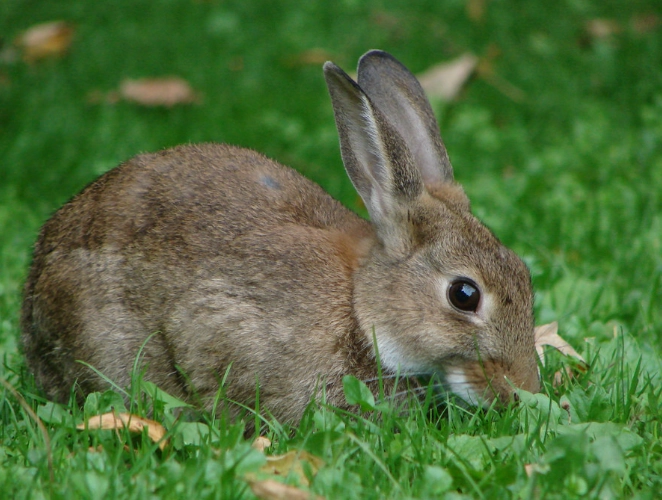
What You'll Find in This Guide
How Did European Rabbits Get to the US?
Unlike Australia's infamous 1859 introduction by Thomas Austin, the US never had a coordinated, large-scale release of European rabbits for hunting. The history here is more scattered and accidental.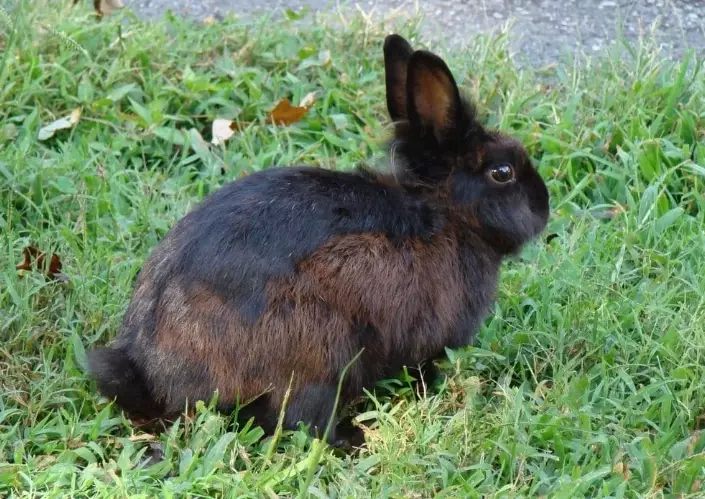
Early European settlers did bring rabbits over, but these were mostly for food and fur in controlled settings. The idea of establishing wild populations for sport hunting never really took hold on the mainland. Why? We already had plenty of native rabbit species (cottontails and hares) that filled that ecological and recreational niche. Releasing a non-native competitor seemed unnecessary to most.
The primary vector for European rabbits in modern America has been the pet trade and subsequent releases or escapes. From the 1960s onward, European rabbits (often marketed as "Dutch" rabbits, a breed of the European species) became popular household pets. People who could no longer care for them sometimes "set them free," not realizing the consequences. A pair of released pet rabbits can establish a colony surprisingly fast if conditions are right.
There were also a few ill-advised, small-scale introductions. One documented case involves rabbits released on islands off the coast of Washington state in the early 20th century, likely by homesteaders wanting a ready food source. These isolated populations are the ones that persist and cause issues today.
A Key Distinction: When we talk about "wild rabbits" in America, we're almost always talking about native Sylvilagus species (cottontails). The European rabbit (Oryctolagus cuniculus) is a different genus entirely. This is the first mistake many people make—assuming all brown, hopping lagomorphs are the same.
Where Are European Rabbits Found in the US Today?
You won't find them roaming the Great Plains or the forests of Appalachia. Feral European rabbit populations are confined to specific, often insular, locations. Their establishment requires a combination of escaped/released founders and an environment without extreme winters or overwhelming predator pressure.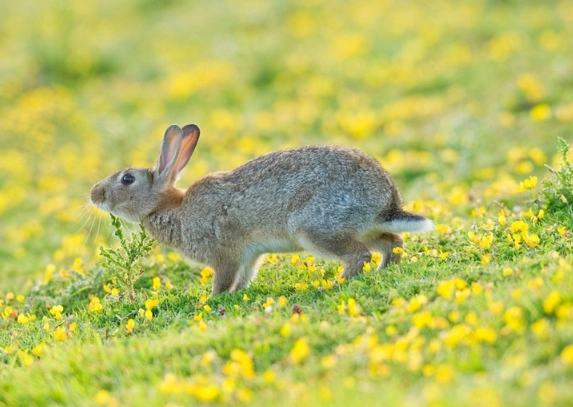
Hotspots of Feral European Rabbit Activity
The San Juan Islands, Washington: This is perhaps the most famous and studied feral population. Rabbits, descendants of pets and farm releases, have lived on several islands for decades. On San Juan Island itself, they've become a visible part of the landscape in certain areas, like the American Camp unit of the San Juan Island National Historical Park. The National Park Service has had to manage them due to their impact on historic grasslands and competition with native species.
Martha's Vineyard, Massachusetts: Another island, another population. Rabbits here are believed to be descended from released pets. They're present in enough numbers to be considered a persistent non-native population.
Localized Urban and Suburban Colonies: Across the country, from California to Florida, temporary colonies pop up when pet rabbits are abandoned. These often don't last more than a few generations due to predation, disease, or control efforts by animal services. A well-known past example was a colony at the University of Victoria in British Columbia, Canada (just north of Washington), which was eventually relocated.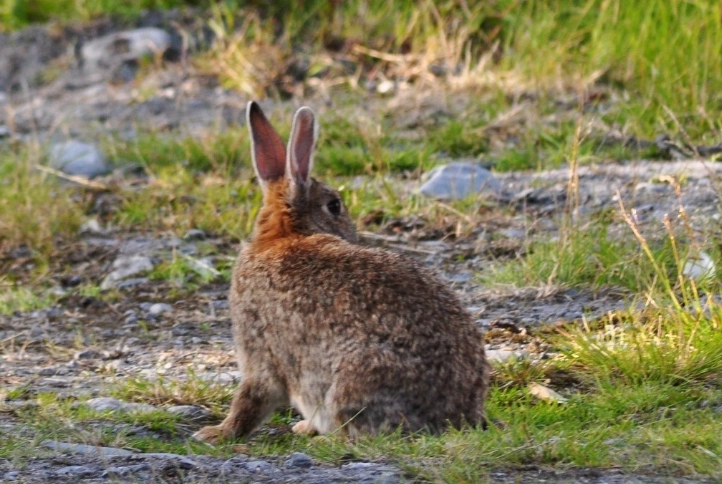
It's crucial to understand these are pocket populations. They don't represent a continent-wide invasion like in Australia. Their isolation is what has both allowed them to survive and prevented them from spreading uncontrollably.
Are European Rabbits Considered Invasive in the US?
In the specific locations where they have established feral populations, absolutely yes. The US Department of Agriculture and state wildlife agencies classify feral European rabbits as an invasive species in contexts where they damage ecosystems or agriculture.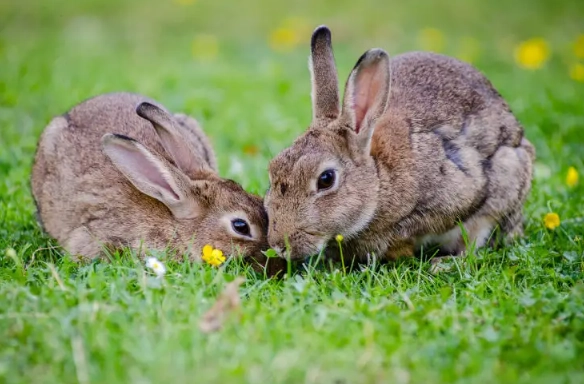
Let's break down why they're problematic, even in small numbers:
- Habitat Destruction: They are prolific diggers of extensive warrens. This destabilizes soil, accelerates erosion (especially on coastal bluffs like in the San Juans), and damages the root systems of native plants.
- Competition with Natives: They compete directly with native cottontails and other small herbivores for food and shelter. European rabbits are often more aggressive and efficient foragers.
- Agricultural and Garden Pests: When they live near farms or suburbs, they will readily devour vegetable crops, ornamental plants, and seedlings. A small group can wipe out a garden overnight.
- Disease Reservoirs: They can carry and spread diseases like Rabbit Hemorrhagic Disease (RHDV2), which is a major threat to both wild native lagomorphs and the domestic rabbit industry.
| Trait | European Rabbit (Oryctolagus cuniculus) | Eastern Cottontail (Sylvilagus floridanus) - A Common Native |
|---|---|---|
| Social Structure | Highly social, lives in large communal warrens. | Largely solitary, uses simple shallow forms for shelter. |
| Digging Behavior | Extensive, complex burrow systems. | Does not dig burrows; may use others' abandoned holes. |
| Ear Shape | Generally shorter relative to head, rounded tips. | Longer, more prominent ears. |
| Hind Legs | Shorter, built for powerful digging. | Longer, built for explosive sprinting. |
| Primary US Status | Localized feral/invasive populations. | Widespread native species. |
The table above shows why a feral European rabbit colony is ecologically different from a population of native cottontails. The warren-building alone changes the physical landscape.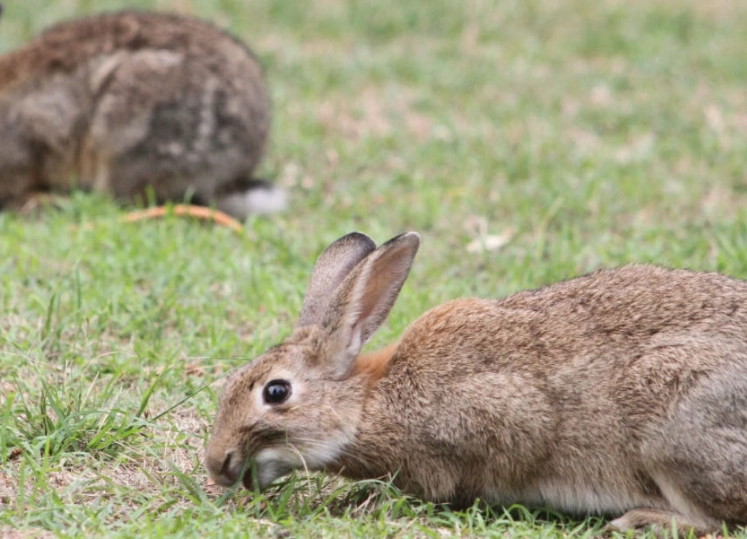
Managing European Rabbit Populations in the US
Management is handled on a case-by-case basis by local wildlife authorities, land managers, or municipalities. There is no one-size-fits-all approach, but the goal is always to protect native ecosystems and agriculture.
On public lands like the San Juan Island National Historical Park, the National Park Service has engaged in controlled removal programs. These are sensitive operations, often involving live-trapping and relocation to animal sanctuaries, or in some cases, more direct population control methods. Public education is a huge component—teaching visitors not to feed the rabbits and explaining why they are a problem.
For private landowners, the options vary by state. In many states, European rabbits are not protected game animals, meaning they can be humanely dispatched if they are causing property damage, similar to other invasive species like nutria. However, local ordinances must always be checked first.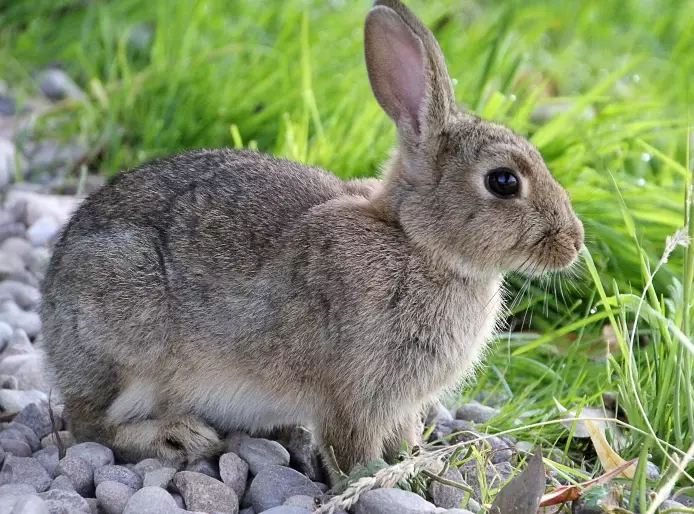
The most critical management tool is prevention. This is where the pet trade connection comes back into focus. Responsible pet ownership is non-negotiable.
- Never release a pet rabbit into the wild. It's cruel (most domestic breeds cannot survive) and ecologically reckless. If you can no longer care for your rabbit, surrender it to a rescue shelter.
- Spay or neuter your pet rabbits. This prevents accidental litters that might lead to abandonment.
- Be aware of state laws. Some states, like California, have strict regulations about importing or possessing European rabbits due to disease risks.
I've spoken with wildlife rehabilitators who constantly deal with the fallout of abandoned "Easter bunnies." The ones that survive join or form these feral colonies, and the cycle continues. Breaking that cycle is the single most effective thing we can do.
Your Questions Answered
If I see a rabbit in my yard in the US, is it a European rabbit?
It's very unlikely. You're almost certainly looking at a native cottontail. Key signs it's a cottontail: longer ears and legs, a white puff-tail, and solitary behavior. European rabbits are stockier with shorter ears, and if you see one, you'll often see several others nearby emerging from burrows.
Is it legal to own a European rabbit as a pet in the US?
Generally, yes. Most domestic rabbit breeds are derived from the European rabbit and are legal pets. However, some cities have ordinances restricting rabbit ownership, and a few states may have health-related restrictions. Always check local laws. The legal problem arises when they are released or escape to form feral populations.
What should I do if I suspect a feral European rabbit colony in my area?
Don't try to handle it yourself. Contact your state's Department of Fish and Wildlife or your local county animal control office. Describe what you're seeing (number of rabbits, burrow systems, location). They have the expertise to identify the species and determine if management action is needed.
Could European rabbits ever become a widespread problem in the US like in Australia?
Most ecologists think it's improbable for the mainland. We have harsh winters in many regions that they aren't well-adapted to, and we have a full suite of predators (coyotes, foxes, hawks, eagles) that keep rabbit numbers in check. Our native cottontails are also fierce competitors. The real risk is on islands or in specific ecologically sensitive areas where these natural checks are absent.
Do European rabbits in the US impact agriculture significantly?
Not on a national scale, but they can be severely damaging at the local level. A vineyard on one of the San Juan Islands or a community garden near a feral colony can experience significant crop loss. For individual farmers in these hotspots, they are a genuine pest.
Comment